Part 1 – Gear & Optics for Professional Macro Photography
Understanding True Macro: 1:1 Magnification and Beyond
In fine art macro photography, “macro” has a precise technical definition. A true macro lens achieves at least 1:1 reproduction ratio, meaning the subject is recorded on the camera sensor at life size. Anything beyond 1:1 (2:1, 3:1, etc.) moves into high magnification or extreme macro photography.
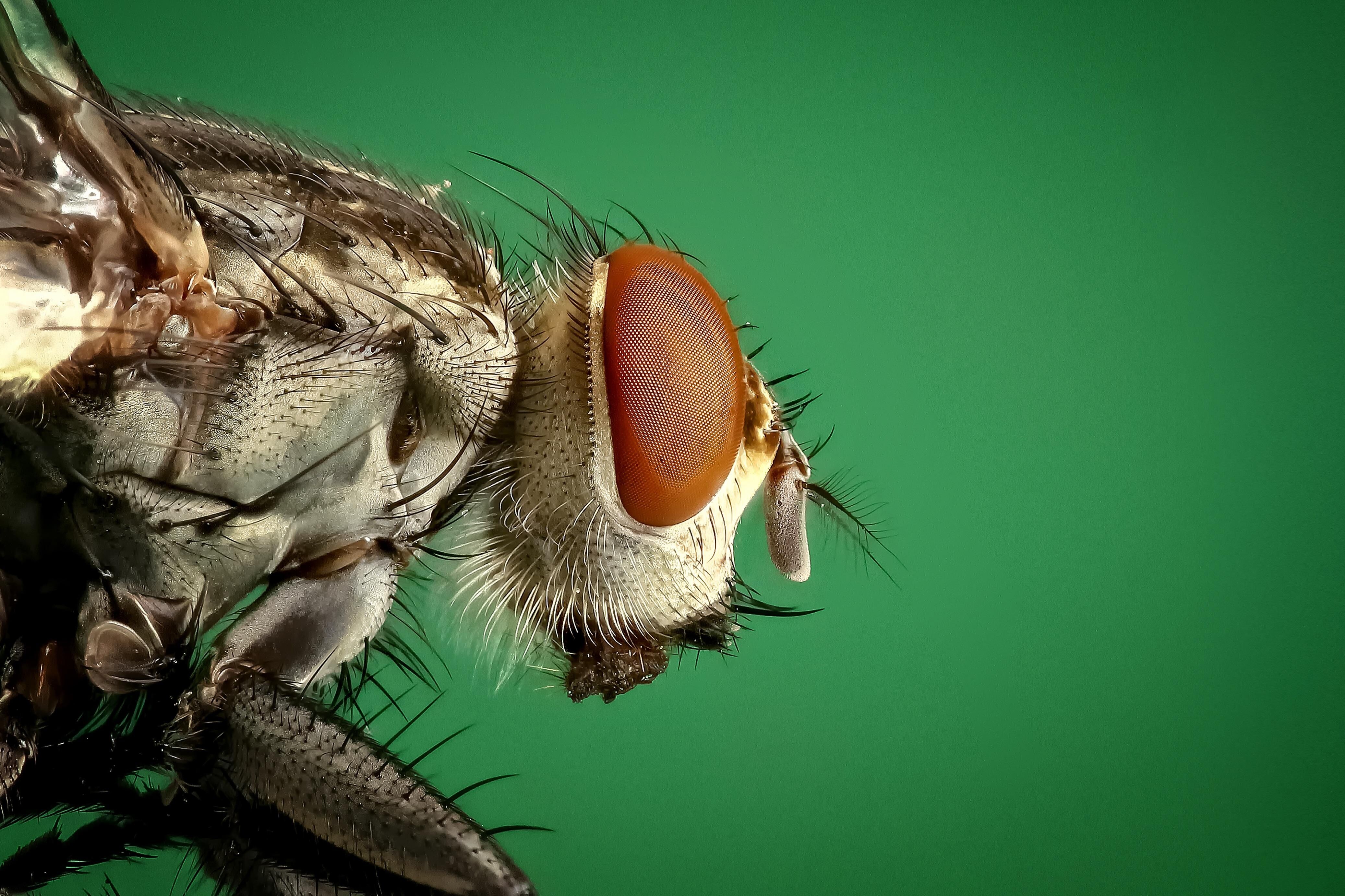
Macro Photography of Brown and Black Fly
Key concepts:
- Reproduction ratio (magnification) = image size on sensor / real subject size
- Working distance = distance from the front of the lens to the subject at a given magnification
- Depth of field (DOF) = razor thin at macro distances, even at small apertures like f/11–f/16
For fine art quality, maintaining sharp detail across critical areas of the subject while controlling background and lighting is essential.
Choosing the Right Macro Lens
For professional macro work, a dedicated macro lens is the most reliable foundation. Common fine art macro focal lengths:
- 60mm macro lens – Ideal for product photography and studio macro where you can work close, less working distance outdoors.
- 90–105mm macro lens – The classic allround macro photography lens for flowers, insects, and detail work; balanced working distance and perspective.
- 150–200mm macro lens – Longer working distance, excellent for shy insects and controlled background compression, but heavier and more demanding to stabilize.
Features to prioritize for high-end macro photography:
- True 1:1 magnification (or beyond for extreme macro)
- Flat field design (minimizes field curvature for edge to edge sharpness in fine art prints)
- Internal focusing (IF) to maintain length and balance.
- Manual focus overrides for precise, critical focusing.
- Minimal focus breathing for consistent composition during focus adjustments
Extension Tubes, CloseUp Filters, and Bellows
If you want to push beyond 1:1 or adapt existing prime lenses for macro work, consider:
- Extension tubes
- Hollow tubes that move the lens farther from the sensor, increasing magnification.
- Preserving image quality is better than cheap closeup filters but reduce light (effective aperture darkens).
- Best used with high quality prime lenses.
- Closeup diopters / closeup filters
- Mounted like filters, function as magnifying glasses.
- High quality, multi-element achromatic diopters can deliver excellent sharpness for macro fine art.
- Useful for travel or lightweight setups.
- Bellows systems
- Highly adjustable extension for extreme macro photography (2:1, 3:1, 5:1).
- Best on sturdy tripods and in studio environments where you can precisely control light and vibration.
Tripods, Focusing Rails, and Stabilization
At macro distances, even the smallest camera movement destroys critical sharpness. For technically perfect images:
- Rigid tripod with a solid head
- Carbon fiber or high grade aluminum for minimal vibration
- Center column lowered or avoided for extra stability.
- Macro focusing rail.
- Allows micro adjustments forward/backward for precise focus and for focus stacking sequences.
- Look for a rail with smooth geared movement and minimal play.
- Remote shutter release or camera self timer
- Combined with mirror lockup or electronic front curtain shutter (EFCS) on DSLRs to minimize internal vibrations.
- On mirrorless cameras, use silent or electronic shutter if it does not introduce rolling shutter artifacts.
- Image stabilization (IBIS / lens IS)
- Helpful for handheld macro but not a substitute for tripod precision.
- Typically turn off stabilization when mounted on a solid tripod for consistent results.
Lighting Tools for Technical Macro Work
Light control is crucial in fine art macro photography:
- Macro flashes and ring flashes – Consistent, controllable light for small apertures and low ISO.
- Twin flash systems – More directional than ring flashes; better for sculpting three dimensional form.
- Portable LED panels and small continuous lights – Great for live view focusing and subtle lighting control.
- Diffusers and reflectors – Soften harsh specular highlights on reflective subjects like insects, water droplets, metal, or glass.
- Flags and gobos – Block unwanted reflections and shape light creatively.